

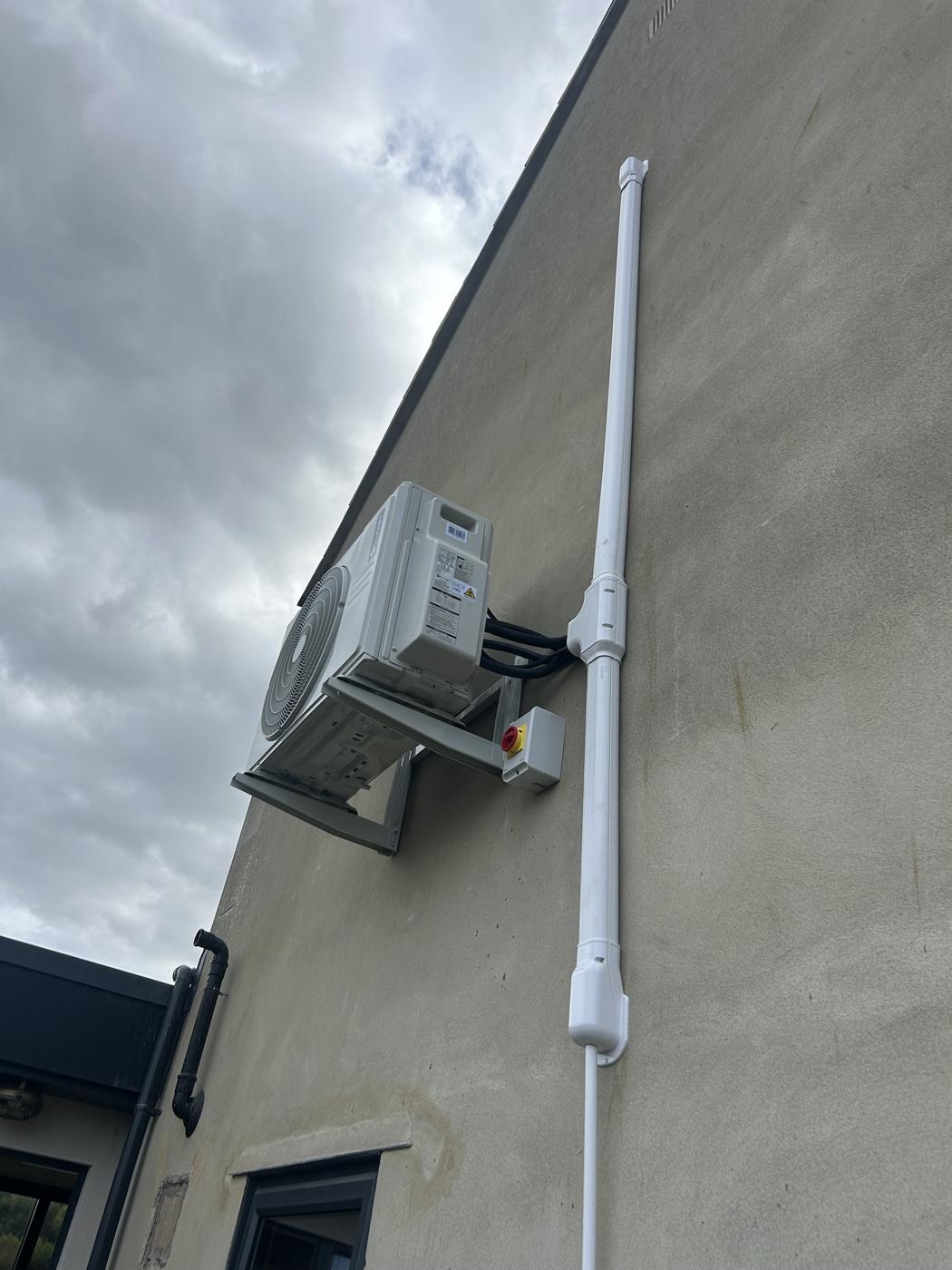
One of the first questions we get at a survey is whether the outdoor unit needs planning permission. For most houses the answer is no, but there are enough exceptions in London and the Home Counties that it is worth understanding the rules before you commit.
Houses: usually permitted development
In England, an air source heat pump on a house is normally permitted development, which means no planning application is needed, as long as it meets a set of conditions. Modern split and multi split air conditioning units are air to air heat pumps, so the same rules apply. The main conditions are:
- Only one outdoor unit is covered by permitted development. A second unit on the same property needs an application.
- The unit must be at least one metre from the edge of your property. A tight side passage on a terrace can fail this test.
- The unit cannot be on a wall or roof that fronts a highway if the building is in a conservation area.
- The unit must not sit on a pitched roof, and on a flat roof it must be at least one metre from the edge.
- The installation should meet the Microgeneration Certification Scheme planning standard or equivalent noise standard, which limits noise at the nearest neighbouring window.
If your property is a detached or semi detached house with a rear garden, one outdoor unit at the back of the house almost always qualifies. Permitted development rights were relaxed in 2025 to remove the previous one metre rule for most houses outside conservation areas, so if you were told no a few years ago it is worth checking again.
Flats: landlord permission first, planning second
Flats do not have the same permitted development rights as houses, and you almost never own the outside wall or the balcony structure. Before anything else, you need written consent from the freeholder or management company. Most leases require it, and a managing agent will usually ask for a specification, a location drawing and a noise figure for the unit. We provide all of that for leasehold clients as part of the survey.
Once the landlord has agreed, the planning question depends on the building. A unit tucked inside a balcony on a rear elevation is often accepted without an application. A unit on a front elevation, a shared roof or a listed block is likely to need one.
Conservation areas
Large parts of Ealing, Chiswick, Richmond, Kew, Hampstead and the older centres of Windsor and Reading are conservation areas. Permitted development still applies, but with a tighter condition: the unit must not be visible from the road on a wall or roof that faces the highway. In practice that means the outdoor unit goes at the rear or on a side elevation that cannot be seen from the street. We plan the position and the pipe route around this at the survey.
Listed buildings
A listed building is the one case where you should assume consent is needed. Fixing an outdoor unit to a listed building, or running pipework through its fabric, needs listed building consent from the council whatever the position. It is not a reason to rule out air conditioning, but it does add time, and the application needs drawings and a method statement. We can produce those for your architect or agent.
Noise
Even where no planning permission is needed, you still have a duty not to cause a noise nuisance. Modern outdoor units are quiet, typically in the range of a domestic fridge at a few metres, but position still matters. We avoid placing units directly below a neighbour's bedroom window, use anti vibration mounts as standard, and choose equipment with a quiet night mode where the site calls for it.
What to check before you book
- Is the property a house or a flat? Flats need freeholder consent first.
- Is it listed? Listed buildings need listed building consent.
- Is it in a conservation area? Keep the unit off the front of the building.
- Do you already have an outdoor unit? A second one needs an application.
- Where could the unit sit so it is at least a metre from the boundary and away from neighbours' windows?
Planning rules change, and your local council has the final say on what applies to your property. If you are unsure, we will tell you at the survey whether we think an application is needed, and we can point you to the right planning officer or produce the drawings an application requires.
Written by Zakaria Sinjab, F-Gas Category 1 certified engineer and director of Zephyr Climate Ltd.
